

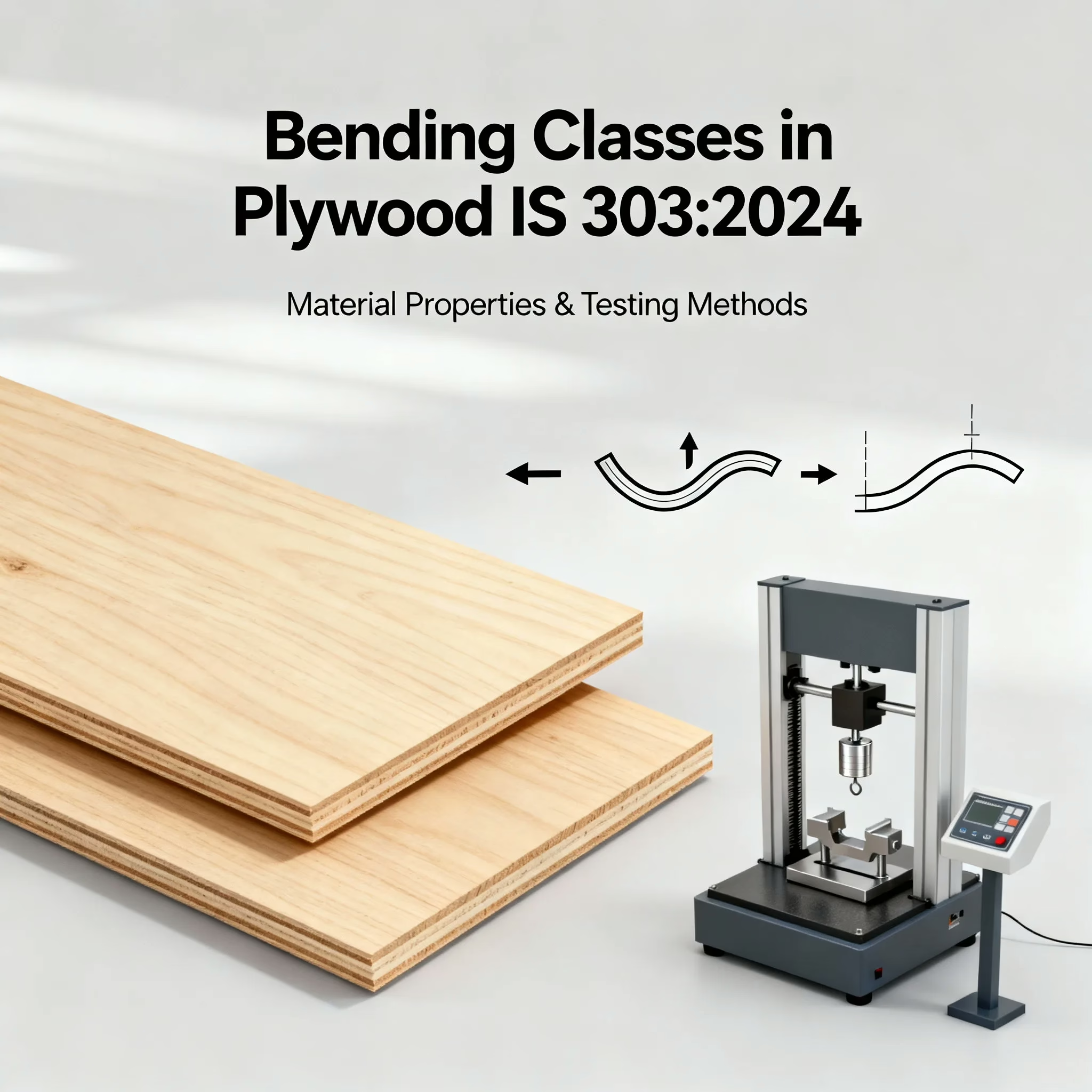
The Bureau of Indian Standards (BIS) recently introduced bending classes under IS 303:2024 (2nd Amendment) for General-Purpose Plywood.
This change divides plywood into five strength categories — from F10 (lightest) to F50 (strongest) — based on static bending strength.
📜 Why the Amendment Matters
Previously, all ISI certified plywood had to meet a single minimum bending requirement (For MR Grade: MoR ≥ 15 N/mm², MoE ≥ 2100 N/mm²).
Now, manufacturers can produce different grades depending on timber quality — ensuring cost-effective options for lighter use and stringent standards for structural applications.
🧪 What Is Static Bending Strength?
Static bending strength measures how plywood behaves when bent under load. It has two key components:
| Property | Full Name | Meaning | Analogy |
|---|---|---|---|
| MoR | Modulus of Rupture | The maximum bending stress the plywood can withstand before breaking. | 💪 Like testing how much a stick can bend before it snaps. |
| MoE | Modulus of Elasticity | The stiffness of the plywood — how much it flexes under load. | ⚙️ Like comparing a steel ruler (stiff) vs. a plastic ruler (flexible) |
📊 Bending Classes and Their Applications
| Bending Class (F) | MoE Requirement (N/mm²) | MoR Requirement (N/mm²) | Recommended Use Case | Strength Analogy |
|---|---|---|---|---|
| F10 | 1,000 | 10 | Light interior work – wall panels, ceilings, furniture backs, or partitions. | 🧃 Like a thin cardboard sheet – light and flexible. |
| F20 | 2,000 | 20 | Standard furniture, wardrobes, cabinets, shelves. | 📚 Like a sturdy book cover – firm, not for heavy stress. |
| F30 | 3,000 | 30 | Doors, tables, moderate-duty structural panels. | 🚪 Like a solid wooden door – tough under daily use. |
| F40 | 4,000 | 40 | Heavy-duty furniture, kitchen tops, formwork. | 🪑 Like a hardwood chair frame – strong and stable. |
| F50 | 5,000 | 50 | Load-bearing, outdoor, or marine uses (truck floors, docks). | 🚚 Like a truck platform – rigid and rugged. |
🧭 Choosing the Right Bending Class
- 🏠 Home interiors: F10–F20
- 🚪 Furniture and doors: F30
- 🏗️ Construction and shuttering: F40
- 🌊 Heavy-duty or outdoor use: F50
This classification helps customers buy plywood suited to their purpose instead of overpaying for strength they don’t need.
✳️ In Summary
The introduction of bending classes under IS 303:2024 is a progressive step by BIS, enabling the plywood industry to:
- Offer products across strength levels.
- Maintain quality consistency under QCO.
- Help buyers make informed, application-specific choices.